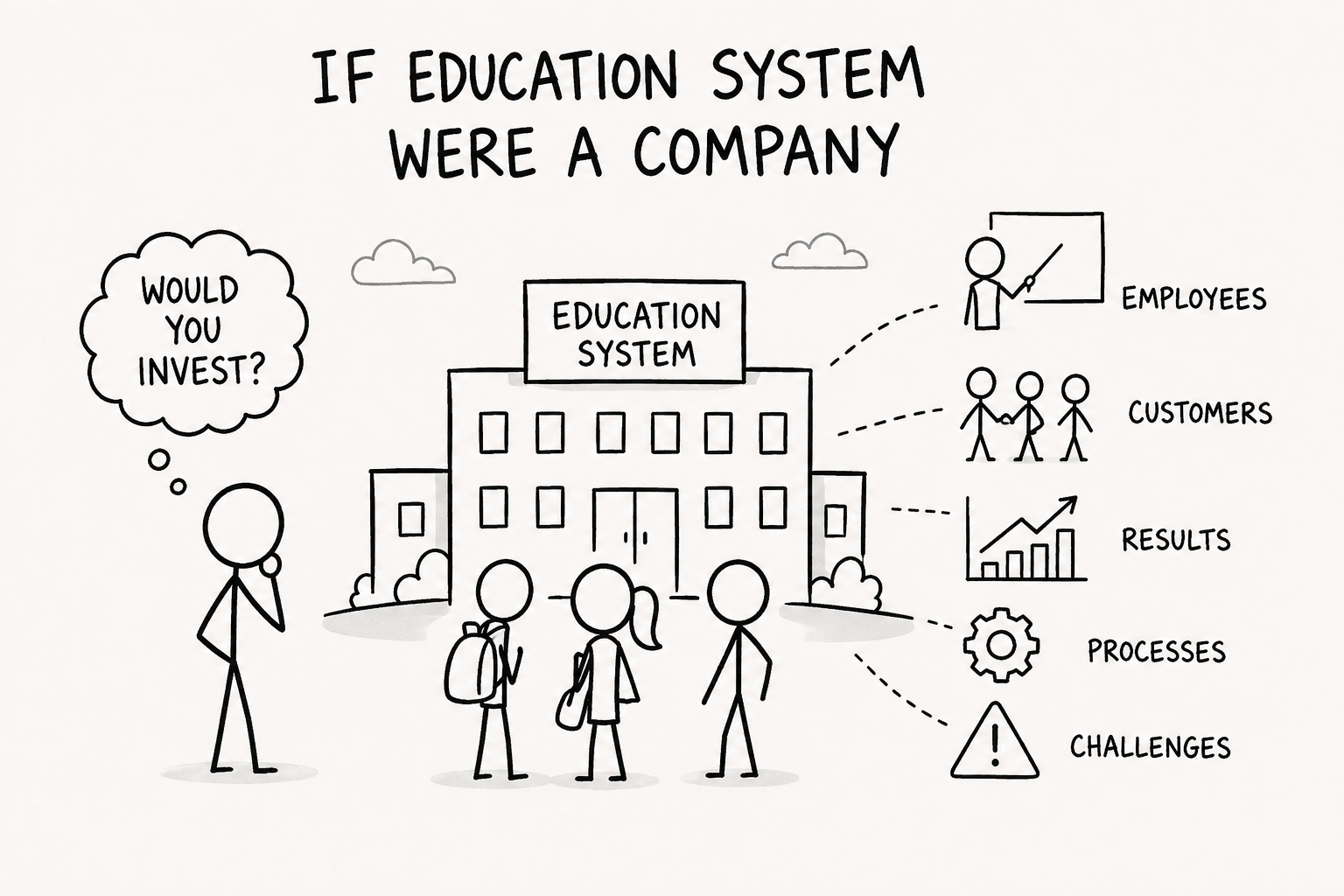
Imagine education not as a public institution, but as a company. Look at its customers, incentives, processes, outcomes and ability to adapt. Then ask a question we rarely ask: would we consider it well managed?
Imagine someone pitching you a company.
It has existed for more than a century.
It employs millions of highly educated professionals.
Governments spend enormous amounts of money on it every year.
Almost every person in society uses its services.
Participation is effectively guaranteed.
Demand is not the problem.
Competition is limited.
And the company has access to perhaps the most valuable raw material imaginable:
human potential.
Sounds like an extraordinary business.
Then you start asking questions.
What does the company actually optimize for?
How does it measure whether its customers succeed?
What happens when customers consistently fail?
How quickly does the organization respond when the world changes?
Who is accountable when outcomes are poor?
Which departments benefit from maintaining the existing system?
And perhaps most importantly:
Who has an incentive to tell the truth when something isn't working?
Suddenly, the investment starts looking considerably more complicated.
The Customers Can't Leave
Most companies have a brutally effective feedback mechanism.
Customers.
If the product is bad, customers leave.
If the service is frustrating, customers complain.
If a competitor creates something dramatically better, market share moves.
Education works differently.
Students generally cannot simply decide:
“This learning experience isn't working for me. I'm switching providers tomorrow.”
They remain inside the system.
That changes the incentives.
A restaurant that repeatedly serves terrible food eventually has an empty dining room.
A school can have deeply disengaged students and still have a full classroom on Monday morning.
That doesn't mean schools don't care.
It means the normal feedback mechanism connecting customer satisfaction, outcomes and organizational survival is unusually weak.
And weak feedback loops create strange organizations.
Imagine the Customer Saying, “Your Product Doesn't Work”
Now imagine a customer tells a company:
“Your product doesn't work for me.”
And the company responds:
“You need to try harder.”
Sometimes that might actually be true.
Students have responsibilities.
Parents have responsibilities.
Teachers cannot manufacture motivation from nothing.
But if thousands or millions of customers repeatedly struggle with the same product, a competent company eventually asks another question:
Could something about the product be causing the problem?
If students repeatedly lose motivation, perhaps motivation isn't merely a student characteristic.
If students repeatedly forget what they supposedly learned, perhaps retention deserves more attention.
If students repeatedly cannot connect schoolwork with meaningful goals, perhaps relevance matters.
If students repeatedly conclude that they are “bad at learning,” perhaps we should investigate how that belief was created.
A serious company would study these failure patterns obsessively.
Education sometimes treats them as personality traits.
The KPIs Would Terrify an Investor
Every company needs metrics.
Education has plenty.
Attendance.
Grades.
Test scores.
Graduation rates.
Credits completed.
Course completion.
University admission.
But imagine presenting those metrics at a board meeting.
An investor might ask:
What percentage of what students learn can they still use five years later?
Silence.
How many students leave your system knowing how they personally learn most effectively?
Hard to measure.
How many can identify gaps in their own knowledge and independently close them?
Not really tracked.
How many students become more curious during their time with you?
Interesting question.
How many leave believing they are incapable of learning certain things?
We probably don't want that KPI.
And then comes the uncomfortable question:
Are we measuring what matters, or what is easiest to measure?
Those are not the same thing.
The Company Would Have a Serious Innovation Problem
Imagine another slide in the investor presentation.
The outside world has changed dramatically.
Information that once required a library can now be accessed instantly.
AI can explain concepts.
Generate exercises.
Translate materials.
Create examples.
Provide feedback.
Adapt difficulty.
Answer questions at midnight.
Repeat an explanation twenty times without becoming impatient.
Meanwhile, many classrooms still operate around a basic architecture that would be recognizable to someone from generations ago:
A teacher.
A group of similarly aged students.
A timetable.
A curriculum.
Lessons.
Assignments.
Tests.
Grades.
That doesn't automatically make the model bad.
Old things can work.
But if a company watched its technological environment transform while leaving its fundamental operating model largely intact, investors would at least ask:
Why?
Then We Would Meet the Stakeholders
This is where things become more interesting.
Because education isn't really one company.
It is an ecosystem.
Students.
Parents.
Teachers.
School administrators.
Municipalities.
Governments.
Teacher education programs.
Universities.
Publishers.
Technology companies.
Consultants.
Researchers.
Unions.
Politicians.
Each group may genuinely want better education.
But each also has its own incentives.
And incentives matter.
A politician may need results before the next election.
A school administrator may need stability.
A teacher may need manageable workload and classroom conditions.
A parent may care primarily about their own child.
A university may care about admissions and research.
A publisher may benefit from curriculum changes.
An EdTech company may benefit from convincing schools that technology is the solution.
None of this requires corruption.
That is what makes the problem more difficult.
People can behave completely rationally within their own incentives while the overall system produces irrational outcomes.
This Is Where Ethical Fading Becomes Dangerous
Imagine a company where everyone cares about the mission.
Nobody wakes up thinking:
“How can I make education worse today?”
Yet problems can still become normalized.
A student stops participating.
We call them unmotivated.
A class repeatedly performs poorly.
We lower expectations.
Teachers become overwhelmed.
We call it part of the profession.
Students memorize information for exams and forget it shortly afterward.
We call the course completed.
A child struggles for years and eventually concludes:
“I'm just stupid.”
We call it low academic self-confidence.
Language matters.
Because sometimes professional terminology doesn't merely describe problems.
It makes them easier to live with.
That is one form of ethical fading:
the human consequence slowly disappears behind procedures, categories, metrics and institutional language.
Nobody needs to intentionally hide the problem.
The system simply becomes very good at describing it without solving it.
A Company Would Ask About Churn
Education has another strange characteristic.
Its most dissatisfied users often don't technically leave.
They remain physically present while mentally checking out.
Imagine a software company reporting:
“Good news. Customer retention is 98%.”
Then someone examines the data more closely.
Half the users stopped meaningfully using the product months ago.
They still have accounts.
They still log in because they have to.
But engagement has collapsed.
No serious company would call that successful retention.
Yet education can sometimes mistake attendance for engagement.
A student sitting in a classroom is not necessarily learning.
A completed assignment does not necessarily represent understanding.
A passed exam does not necessarily represent durable knowledge.
And graduation does not automatically mean the system succeeded.
The Employees Might Be the Least of the Problem
If this sounds like criticism of teachers, it shouldn't.
Imagine putting talented employees inside a badly designed company.
Give them too many customers.
Give those customers radically different needs.
Create rigid schedules.
Add administrative work.
Frequently change requirements.
Limit resources.
Introduce new technology without removing old responsibilities.
Measure performance imperfectly.
Then tell the employees:
“Be innovative.”
That isn't an employee problem.
That's organizational design.
Many teachers are doing extraordinary work despite the system around them.
Which raises an uncomfortable possibility:
What if education works as well as it does partly because teachers constantly compensate for weaknesses in the system?
A company dependent on employee heroics is not necessarily a well-designed company.
It may simply have excellent employees.
The Board Would Eventually Ask the Most Important Question
Every serious organization eventually has to answer:
What are we actually trying to accomplish?
Produce graduates?
Transfer knowledge?
Prepare people for employment?
Create responsible citizens?
Develop independent thinkers?
Build confidence?
Teach people how to learn?
Reduce inequality?
Prepare children for adulthood?
All of them?
Because if the desired outcome is unclear, optimization becomes almost impossible.
You cannot design the right system until you know what the system is supposed to produce.
And perhaps that is one of education's deepest problems.
We endlessly debate methods before agreeing on outcomes.
Technology versus traditional teaching.
Homework versus no homework.
Phones versus phone bans.
AI versus no AI.
Tests versus alternative assessment.
But these are implementation questions.
The strategic question comes first:
What should a human being be capable of when they leave the education system?
Would You Invest?
So imagine the education system really were a company.
It has enormous resources.
Extraordinary employees.
Guaranteed customers.
Massive social importance.
Access to incredible technology.
And a product capable of changing someone's entire life.
But it also has weak feedback loops.
Conflicting stakeholders.
Ambiguous success metrics.
Slow organizational change.
Customers who cannot easily leave.
Employees compensating for structural problems.
And failure modes that can persist for decades without threatening the organization's existence.
Would you invest?
Maybe.
Because the opportunity is enormous.
But any serious investor would demand something before writing the cheque:
a much clearer explanation of what the company is trying to achieve, how it knows whether it is achieving it, and who is willing to say when it isn't.
Education doesn't need to become a business.
Students aren't products.
Teachers aren't production workers.
And learning cannot be reduced to quarterly earnings.
But education could borrow one useful habit from organizations whose survival depends on reality:
When the outcomes aren't good enough, don't protect the process just because the process is familiar.
Question it.
Measure it.
Challenge the incentives around it.
Listen to the people experiencing it.
And above all, make it safe for someone to say:
This isn't working.
Because the most dangerous education system isn't one that has problems.
Every system has problems.
It's one where too many people have an incentive not to see them.